Eclipses
When is the solar eclipse in 2027?
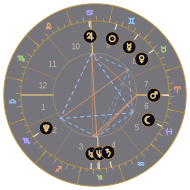
As of 16 Nov 2026, there are two solar eclipses in 2027. The annular eclipse is on 6 Feb 2027, 15:59 UTC, in Aquarius. The total eclipse is on 2 Aug 2027, 10:06 UTC, in Leo, greatest near 25.5° N, 33.2° E.
Next:
- Annular
- 6 Feb 2027, 15:59 UTC · Aquarius 17°38′
- Total
- 2 Aug 2027, 10:06 UTC · Leo 9°55′
- Greatest eclipse
- 25.5° N, 33.2° E (total)
From your city
What your city sees
Whether you see a total eclipse, a thin bite out of the Sun or nothing at all depends on where you stand. Pick a city below and the page works out both eclipses of 2027 for that spot, in your browser. You get the kind of eclipse seen there and how much of the Sun is covered. You also get the contact times on the local clock and the Sun's height at the deepest moment.
The dates
The solar eclipses of 2027
Two solar eclipses fall in 2027. The first is annular, on 6 Feb 2027, 15:59 UTC, with the Sun and Moon together in Aquarius. The second is total, on 2 Aug 2027, 10:06 UTC, in Leo. The table gives each instant of greatest eclipse in UTC, the degree where the two bodies meet and the point on Earth where the shadow passes most centrally. Your own clock time appears beside each instant once the page has loaded.
| Eclipse | Instant | Sun and Moon at | Greatest eclipse |
|---|---|---|---|
| Annular | Aquarius 17°38′ | 31.3° S, 48.5° W | |
| Total | Leo 9°55′ | 25.5° N, 33.2° E |
Annular eclipse of 6 Feb 2027: At greatest eclipse the Moon covers about 86 % of the Sun's area and leaves a bright ring.
Total eclipse of 2 Aug 2027: At greatest eclipse the Moon covers the whole Sun.
Where it is total
Where the 2 Aug 2027 eclipse is total
The Moon's dark inner shadow is narrow, so totality is seen only along a thin band that sweeps across the globe in a few hours. On 2 Aug 2027 that band crosses the southern tip of Spain and Gibraltar, then Morocco, Algeria, Tunisia, Libya and Egypt. It continues over Saudi Arabia and Yemen and leaves land in Somalia.
The greatest-eclipse point, at 25.5° N, 33.2° E, lies in the Nile valley of southern Egypt, close to Luxor. Near that point the Sun stands almost overhead around midday, and the dark phase lasts longer than almost anywhere else on the track.
Beyond the band the Moon covers only part of the Sun. A partial eclipse reaches a much wider area, across much of Europe, Africa, the Middle East and western and southern Asia. The nearer a city sits to the band, the deeper its bite.
Weather matters as much as geography. A clear horizon and a dry sky are worth more than a few extra seconds of darkness. Check the city card for the Sun's height before you choose a spot.
Sources: NASA's table of the decade's solar eclipses lists totality on 2 Aug 2027 in Morocco, Spain, Algeria, Libya, Egypt, Saudi Arabia, Yemen and Somalia. Outside the band it lists a partial eclipse across Africa, Europe, the Middle East and western and southern Asia, and for the annular eclipse of 6 Feb 2027 a ring over Chile, Argentina and the Atlantic. Those tables are by Fred Espenak at NASA's Goddard Space Flight Center.
This site's own engine also puts Gibraltar and Sfax, in Tunisia, inside the band of totality. The city check above computes any other place the same way.
Total and annular
Why one is total and the other a ring
The Moon's distance from Earth changes through its orbit, so its disc looks slightly larger at some eclipses and slightly smaller at others. When the Moon is near enough to look bigger than the Sun, it can hide the whole bright surface. That is totality, and only then does the faint outer atmosphere of the Sun, the corona, come into view.
When the Moon is farther away, its disc is a little too small. Even when it sits dead centre, a ring of sunlight stays around its edge. That is an annular eclipse, and the eclipse of 6 Feb 2027 is one. A thin bright ring stays around the Moon even at the deepest moment. The sky dims, but it never goes dark the way it does in totality.
The annular eclipse is centred far to the south. Its greatest-eclipse point, 31.3° S, 48.5° W, lies in the South Atlantic off southern Brazil. Its ring is seen along a track over South America and the South Atlantic, and Europe, Asia and North America do not see it at all.
Both kinds begin and end with a partial phase, when the Moon covers only part of the Sun. For most readers, that partial phase is the whole event.
Your sign
The 2027 eclipses for your rising sign
Each eclipse falls in one whole-sign house of your chart, counted from your rising sign. Find your rising sign below to see both houses. If you do not know it, the birth chart calculator finds it from your birth time. You can also read the list by your Sun sign for a second view.
Aries rising — your 11th house, then your 5th house
The annular eclipse of 6 Feb falls in your 11th house; The total eclipse of 2 Aug falls in your 5th house.
Your fifth house is play, romance, children and anything you make for the joy of making it. An eclipse here tends to light up a creative idea or a new attachment. Give it a small, real start: a page written, a sketch, an evening out with someone who makes you laugh. Delight is reason enough to begin here.
Taurus rising — your 10th house, then your 4th house
The annular eclipse of 6 Feb falls in your 10th house; The total eclipse of 2 Aug falls in your 4th house.
The fourth house is home, family and the place you come back to at night. An eclipse here often stirs questions about where you live or who you live with. It can be as plain as rearranging a room or as large as a move. Let the decision take its time, and listen to the people who share the roof.
Gemini rising — your 9th house, then your 3rd house
The annular eclipse of 6 Feb falls in your 9th house; The total eclipse of 2 Aug falls in your 3rd house.
Your third house holds daily conversation, siblings, neighbours and the short trips you make without thinking. An eclipse here tends to bring a message that matters, or a change in the way you talk with someone close. Notice which letters you keep putting off. One phone call to a brother, a sister or a neighbour may open more than you expect.
Cancer rising — your 8th house, then your 2nd house
The annular eclipse of 6 Feb falls in your 8th house; The total eclipse of 2 Aug falls in your 2nd house.
In your second house the eclipse touches what you own and what you earn, and also what you value enough to keep. This is a natural moment to look at where your money and time actually go. A single honest look at one account, or one cupboard, often says more than a long plan written at the kitchen table.
Leo rising — your 7th house, then your 1st house
The annular eclipse of 6 Feb falls in your 7th house; The total eclipse of 2 Aug falls in your 1st house.
A solar eclipse in your first house falls on how you meet the world. That means your body, your face and the way you walk into a room. Many people notice a wish to change how they present themselves. You might start with something small, a haircut or a new habit, and see how it settles before going further.
Virgo rising — your 6th house, then your 12th house
The annular eclipse of 6 Feb falls in your 6th house; The total eclipse of 2 Aug falls in your 12th house.
Your twelfth house is rest, solitude and the things you keep out of sight, even from yourself. An eclipse here often asks for quiet rather than action. Make room for sleep, a walk alone or a few pages in a private notebook. What surfaces in a calm hour can guide the busier months that follow it.
Libra rising — your 5th house, then your 11th house
The annular eclipse of 6 Feb falls in your 5th house; The total eclipse of 2 Aug falls in your 11th house.
The eleventh house is friends, groups and the hopes you share with them. An eclipse here tends to change a circle: someone joins, someone drifts off, or you outgrow a club. Look at where you spend your free evenings. A fresh group, a neighbourhood project or an old friend you miss may deserve the time you have.
Scorpio rising — your 4th house, then your 10th house
The annular eclipse of 6 Feb falls in your 4th house; The total eclipse of 2 Aug falls in your 10th house.
In your tenth house the eclipse falls on career, reputation and the role people see you in. Many people find a shift at work or in their public standing around this time. You might name the next step you want, out loud, to the person who can help with it. Be clear about what you are offering and what you need.
Sagittarius rising — your 3rd house, then your 9th house
The annular eclipse of 6 Feb falls in your 3rd house; The total eclipse of 2 Aug falls in your 9th house.
The ninth house is long journeys, study, belief and the wider view. An eclipse here often stirs a wish to travel, enrol or rethink an opinion you have held for years. Pick one thread to follow, a course, a trip or a book you have meant to read, and give it a real place in your calendar.
Capricorn rising — your 2nd house, then your 8th house
The annular eclipse of 6 Feb falls in your 2nd house; The total eclipse of 2 Aug falls in your 8th house.
Your eighth house holds what is shared: joint money, debts, inheritance and the trust that lets two people lean on each other. An eclipse here tends to bring a shared arrangement into the open. Reread one agreement, a loan or a joint account, and see whether it still says what both of you mean today.
Aquarius rising — your 1st house, then your 7th house
The annular eclipse of 6 Feb falls in your 1st house; The total eclipse of 2 Aug falls in your 7th house.
The seventh house belongs to the other person: a partner, a close collaborator, someone you have an agreement with. An eclipse here often marks a turn in one of those bonds. A conversation about what each of you expects can clear the air. Ask the question plainly, then give the answer room before you decide anything.
Pisces rising — your 12th house, then your 6th house
The annular eclipse of 6 Feb falls in your 12th house; The total eclipse of 2 Aug falls in your 6th house.
In your sixth house the eclipse lands on daily work, chores and the routines that keep your body going. Many people find that one habit no longer fits. You could change the order of your morning, the way you share tasks at work, or the hour you go to bed. A modest change kept for a month counts for more than a sweeping one.
Watching safely
How to watch a solar eclipse safely
Looking at the Sun is never safe with the naked eye, and an eclipse does not change that. The bright surface still reaches your eyes while the Moon covers part of it, and the harm is painless at the time.
Use eclipse glasses or a handheld viewer that meets the international standard ISO 12312-2, from a seller you can trust. Ordinary sunglasses, even very dark ones, are far too weak. Check the filter for scratches or holes before each use, and help children keep theirs on.
A camera, binoculars or a telescope needs its own solar filter fixed over the front end. Never look through one of them while wearing eclipse glasses, because the lens gathers far more light than the glasses can block.
You can also watch without looking up at all. Hold a card with a small pinhole a little above a sheet of paper, and a small image of the Sun appears on the paper. The gaps between leaves do the same thing on the ground under a tree.
Only inside the band of totality, and only while the Sun is completely covered, can you take the glasses off. Put them back on as soon as the first bright point of sunlight returns. During the annular eclipse the ring stays bright, so the filter stays on throughout.
Frequently asked questions
When is the 2027 solar eclipse?
Two solar eclipses fall in 2027. The annular eclipse is on 6 Feb 2027, 15:59 UTC, with the Sun in Aquarius, and its ring is seen over South America and the South Atlantic. The total eclipse is on 2 Aug 2027, 10:06 UTC, with the Sun in Leo. It is the one most readers mean. Your own local time appears beside each instant near the top of the page.
Where is the total eclipse of 2 Aug 2027 visible?
Totality on 2 Aug 2027 is seen along a narrow band. It crosses the southern tip of Spain and Gibraltar, then Morocco, Algeria, Tunisia, Libya, Egypt, Saudi Arabia, Yemen and Somalia. The greatest-eclipse point lies near Luxor in Egypt. Outside the band the Sun is only partly covered, across much of Europe, Africa, the Middle East and western and southern Asia.
How long does totality last in 2027?
Totality lasts only minutes, and only inside the band. Its length changes from place to place: longest near the centre line and shortest at the edges, where it can shrink to seconds. Pick your city in the card near the top of this page, and the engine gives the length there to the second. Outside the band there is no totality, only a partial eclipse.
What sign is the 2027 solar eclipse in?
The total eclipse of 2 Aug 2027 is in Leo, where the Sun and Moon meet at Leo 9°55′. The annular eclipse of 6 Feb 2027 is in Aquarius, at Aquarius 17°38′. The two signs face each other across the zodiac. That is why the two eclipses fall in opposite houses of any whole-sign chart, as the list of rising signs shows.
Will I see the 2027 solar eclipse from my city?
Pick your city in the card near the top of this page. The engine works out both eclipses for that spot in your browser. It shows whether you get a total, annular or partial eclipse, how much of the Sun is covered and the local contact times. If neither eclipse reaches your sky, it says so and gives the next one you will see.
Method & limits
Astronomy first, reflection second.
Every date here is computed with Astronomy Engine, run once into this site's event tables. They are geocentric, in the tropical zodiac, in UTC to the minute, with your own zone beside them once the page loads. The sentence at the top is dated for the data date shown at the top, midnight UTC. Your browser corrects it against your own clock. Readings are for reflection, never health, legal or money guidance. Nothing about you is sent anywhere.