Full Moon names
When is the Hunter's Moon?
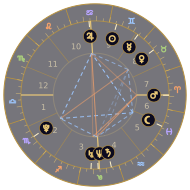
As of 19 Oct 2026, the 2026 Hunter's Moon is the full Moon of 26 Oct 2026, 04:12 UTC, in Taurus.
Next:
- Date
- 26 Oct 2026, 04:12 UTC
- Sign
- Taurus
- Following
- 15 Oct 2027, 13:47 UTC
The dates
Hunter's Moon dates to 2036
The Hunter's Moon of Oct 2026 reaches full at 26 Oct 2026, 04:12 UTC. Use that instant as the anchor. A full Moon is a single moment, and the disk looks full for about a day either side. The later dates in this series run through 2036, so you can see how the calendar shifts from one year to the next. The time is in UTC, so it helps to convert it to your own zone before you plan around moonrise.
| Date | Sign |
|---|---|
| Taurus | |
| Aries | |
| Taurus | |
| Aries | |
| Aries | |
| Taurus | |
| Aries | |
| Aries | |
| Taurus | |
evening of 16 Oct in New York | Aries |
evening of 3 Nov in New York | Taurus |
In 2026 the Harvest Moon is the full Moon of 26 Sep 2026, so the next full Moon, on 26 Oct 2026, is the Hunter's Moon.
The name
Why it is called the Hunter's Moon
The name Hunter's Moon belongs to the stretch of the year after the fields have been cleared. Many farming communities linked the name to that season, when the crops were in and the ground was open to the eye. With the stubble cut and the hedges thinner, a full Moon made it easier to see across a field at night. That is the explanation most often given. It is a tradition people kept and repeated, not a rule anyone can test against the sky.
The name sits inside a longer sequence. Many traditions give each full Moon of the year a name. The names track the season in which the Moon falls rather than the civil month. The Hunter's Moon is the full Moon that follows the Harvest Moon. The Harvest Moon is the full Moon nearest the September equinox, so the Hunter's Moon can fall in October or early November. When the Harvest Moon lands in early October, the Hunter's Moon moves into November. Each one is a separate lunation, which is why this page gives dates rather than a fixed calendar slot.
Some readers ask whether the name describes the Moon itself. It does not. The Moon is not a hunter, and the light does not change its shape to suit the season. The name is a human label placed on a natural event, and it is a label that shifted between regions and centuries. What stays constant is the sky: the Moon reaches full at the instant given in the dates above.
The name works best as a way of noticing the month. A label gives a night a shape. Some people take it as a prompt to step outside after dinner, look east, and see how high the Moon sits above the roofline. Others use it only to mark where they are in the year. Either use is fine, and neither needs the old story to be true.
Looking up
Seeing the 2026 Hunter's Moon
To see the Hunter's Moon at its fullest, plan around 26 Oct 2026, 04:12 UTC rather than the night before or after. The disk looks full for about a day either side, so a clear evening near 26 Oct still rewards a look. A spot with a low view to the east, such as a field edge, a balcony or a quiet street, lets the Moon clear the roofs early.
Moonrise is the most visible part of any full Moon. The Moon rises later each night, by about 50 minutes on average and by less in the weeks after the September equinox at mid-northern latitudes. The best view is often the first look above the horizon. It can appear larger there, an effect that comes from how the eye compares it with trees and rooftops. The Moon itself has not changed size.
Full light flattens the relief, so binoculars show the dark plains and the bright rayed craters rather than shadowed detail. The first look can stay simple. A Moon low in haze often looks warmer in colour than one high in clear air, and that comes from the atmosphere rather than from the season.
If the sky is cloudy on the main night, the evenings either side still show a nearly full disk, so the watch does not depend on one hour. A short note of the time you first saw it above the horizon lets you compare the Moon across years without trusting memory.
The sign
The 2026 Hunter's Moon in Taurus
The 2026 Hunter's Moon falls in Taurus, the sign the Moon occupies at the instant of fullness. A zodiac sign names one section of the sky's band along the ecliptic, and the Moon passes through each section in turn. The sign describes where the Moon sits at that moment, not the whole month.
The sign tells you where the Moon sits along the ecliptic at that moment. It does not set the tone of the evening for anyone. Any meaning you find in the night is yours to keep or set down, and it stays separate from the sky fact.
You can look up the Moon's sign for any date with the moon sign calculator.
Frequently asked questions
When is the Hunter's Moon in 2026?
The 2026 Hunter's Moon reaches full at 26 Oct 2026, 04:12 UTC, which is 26 Oct 2026. That is the instant the Moon sits opposite the Sun. The disk looks full for about a day either side, so a clear evening on either side still shows a bright Moon. The time is given in UTC, so convert it to your own zone before you plan.
Why is it called the Hunter's Moon?
The name is tied to the season after harvest, when fields are cleared and the ground is easier to cross by night. Many communities used it as a marker for the time when hunting was practical. Other names exist for the same full Moon, and the label has shifted across regions and centuries. The reason is a tradition rather than a measured fact about the Moon.
What sign is the 2026 Hunter's Moon in?
The 2026 Hunter's Moon falls in Taurus. The sign is the one the Moon occupies at the instant of fullness, given as 26 Oct 2026, 04:12 UTC. Signs describe position along the sky's band rather than a verdict on the night. The sign shown here is the one for this pass of the Moon, and a later year can carry a different sign.
Is the Hunter's Moon the same night everywhere?
No. The full Moon arrives at one instant for everyone, but the local date and clock time depend on where you stand. Someone far to the east may already be on the next calendar day when the moment comes. Converting the UTC time to your own zone shows the same instant on your clock.
What is the next full Moon after it?
A full Moon follows about a month after this one, one lunation later on the calendar. Its exact instant shifts with the Moon's orbit, so the gap is not the same every time. This page does not name that date, and the time needs a proper lookup rather than a rule of thumb.
Method & limits
Astronomy first, reflection second.
Every date here is computed with Astronomy Engine, run once into this site's event tables. They are geocentric, in the tropical zodiac, in UTC to the minute, with your own zone beside them once the page loads. The sentence at the top is dated for the data date shown at the top, midnight UTC. Your browser corrects it against your own clock. Readings are for reflection, never health, legal or money guidance. Nothing about you is sent anywhere.