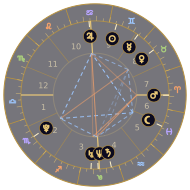
The sky today
Which planets are retrograde right now?
As of 19 Oct 2026, Venus, Saturn, Uranus and Neptune are retrograde. The next station is Mercury turning retrograde at Scorpio 20°59′ on 24 Oct 2026, 07:15 UTC.
Next:
- Retrograde
- Venus, Saturn, Uranus, Neptune
- Next station
- Mercury, 24 Oct 2026, 07:15 UTC
Right now
Every planet's motion today
As of 19 Oct 2026, 4 planets are retrograde. The first table on this page gives each planet's motion and the dates of its current, latest or next retrograde, so the whole picture reads in one place.
A station falls at 24 Oct 2026, 07:15 UTC, when Mercury turns retrograde. A station is the moment a planet's apparent motion changes direction. The tables show the dates on both sides of it.
Each row gives the station that starts the retrograde and the station that ends it. The Motion column names a planet that is in its shadow. The shadow periods are the stretches before and after, when the planet covers the same ground while moving direct.
Nothing on this page forecasts what a day will bring. It is a dated record of apparent motion, the kind of table an ephemeris holds. Read it for the dates and leave the meaning to the reader.
At a glance
Two years of retrogrades at a glance
The calendar
Retrograde calendar for the next two years
The calendar runs from 19 Oct 2026 to 19 Oct 2028. It lists every retrograde window that starts or ends inside that span, so an entry that began before the pin can still appear with its own dates.
Each entry gives the station that starts the retrograde and the station that ends it, with the sign and degree of each. Times are in UTC, and your own zone appears beside each once the page loads.
Use the calendar as a reading list rather than a timetable. A window shows when a planet's apparent path turns. It does not tell you what to do with that turn, and the reader decides that.
The calendar is rebuilt each week from the same ephemeris, so its entries stay accurate as the sky moves on. For the reasons behind the motion, see the retrograde explainer.
| Planet | Turns retrograde | Turns direct |
|---|---|---|
| Neptune | Aries 4°25′ | Aries 1°37′ |
| Saturn | Aries 14°45′ | Aries 7°56′ |
| Uranus | Gemini 5°42′ | Gemini 1°41′ |
| Venus | Scorpio 8°29′ | Libra 22°52′ |
| Mercury | Scorpio 20°59′ | Scorpio 5°02′ |
| Jupiter | Leo 27°01′ | Leo 17°00′ |
| Mars | Virgo 10°26′ | Leo 20°56′ |
| Mercury | Pisces 5°59′ | Aquarius 20°55′ |
| Pluto | Aquarius 7°11′ | Aquarius 4°45′ |
| Mercury | Cancer 6°22′ | Gemini 27°28′ |
| Neptune | Aries 6°40′ | Aries 3°51′ |
| Saturn | Aries 27°53′ | Aries 21°01′ |
| Uranus | Gemini 9°57′ | Gemini 5°56′ |
| Mercury | Scorpio 4°56′ | Libra 19°19′ |
| Jupiter | Virgo 27°31′ | Virgo 17°32′ |
| Mercury | Aquarius 19°42′ | Aquarius 3°59′ |
| Pluto | Aquarius 8°49′ | Aquarius 6°24′ |
| Venus | Gemini 19°41′ | Gemini 3°11′ |
| Mercury | Gemini 16°19′ | Gemini 7°45′ |
| Neptune | Aries 8°54′ | Aries 6°06′ |
| Saturn | Taurus 11°19′ | Taurus 4°25′ |
| Uranus | Gemini 14°14′ | Gemini 10°12′ |
| Mercury | Libra 18°36′ | Libra 3°29′ |
What retrograde is
Why planets seem to move backwards
A planet does not reverse its orbit. It keeps moving in the same direction around the Sun the whole time. What changes is how it looks from Earth, and Earth is moving too.
Earth travels around the Sun faster than the outer planets do, so it passes them. While it passes, a planet seems to slide backwards against the background stars. When the line between Earth and the planet changes again, the planet resumes its usual direction.
The two planets nearest the Sun work differently, because they orbit inside Earth's path. They move faster than Earth and pass it. From Earth, that pass also looks like a reversal, and the table treats it the same way.
The shadow period is the stretch on either side of a retrograde. The planet is moving direct throughout, over the same stretch of sky that the retrograde covers, either just before or just after it. The Motion column of the table names a planet that is in its pre-shadow or post-shadow.
The retrograde is apparent only. Nothing in the planet's motion changes, and no force reverses it. The calendar shows the sign and degree under each date so that a reader can check a window against the sky instead of against memory. For Mercury the record reads: Mercury stays in Scorpio from the station to the direct turn. For Venus it reads: Venus stations in Scorpio and turns direct in Libra.
A line like that says where a window sits. When a station and its direct turn fall in one sign, the line says so, and when they fall in two signs it names both. Read it with the dates.
Some readers of the sky treat these windows as periods of review. This page reports the motion, its dates and its signs, and it leaves the reading to the person who opens it. What a reader makes of a window is up to them.
Planet by planet
How often each planet turns
Mercury turns retrograde more often than any other planet, and its windows are short. Venus turns less often, and its windows run longer. The outer planets turn retrograde about once a year or less, and their windows last for months rather than weeks.
The notes below follow the planets in order from the Sun outward. Each note draws on the calendar above, and each one describes how often its planet turns and how long it stays in retrograde.
Mercury
Each Mercury window usually runs for a few weeks. Its shadow periods on each side can last a couple of weeks too. Read the calendar for the exact station dates and the sign and degree of each turn.
Venus
Venus turns retrograde less often than Mercury does, and each window runs longer. A Venus window usually lasts about six weeks from station to direct turn. Its shadow periods are longer as well, so the stretch around a Venus retrograde is wide. Each Venus entry pairs its two station dates with the sign and degree of each, so the whole window can be checked at a glance. The calendar keeps the dates in UTC, so compare them with your own clock before you plan around one.
Mars
Mars turns retrograde less often than the planets nearer the Sun, roughly once every two years. Each window lasts for a few months rather than weeks. Its shadow periods on each side are long, so a Mars window covers a wide stretch of time. Because the windows are rare, each one is worth reading in full. The calendar lists where each Mars turn falls, so a reader can place the window against the sky.
Jupiter
Jupiter turns retrograde roughly once a year, and each window lasts for about four months. The shadow periods are long, so a Jupiter window reaches well beyond its two turns. Read the station dates and the sign and degree together, since the calendar shows both at each end. Jupiter is the largest planet in the list, and its windows are a steady part of the yearly picture rather than a short event.
Saturn
Saturn turns retrograde roughly once a year, and each window lasts for about four to five months. Its shadow periods run about three months on each side, against a retrograde of four to five months. Saturn moves slowly, so its turns unfold as long, quiet stretches rather than sharp events. The calendar places each Saturn turn in a sign, with its degree, so a reader can follow the planet's slow progress from one window to the next.
Uranus
Uranus turns retrograde roughly once a year, and each window lasts for about five months. It is a slow planet, and its shadow periods run for months on each side. Each Uranus entry in the calendar gives its two station dates, which makes the window easy to follow. Nothing about its window changes the way the planet moves. The turn is a change in how it looks from Earth.
Neptune
Neptune turns retrograde roughly once a year, and each window lasts for about five months. Its shadow periods are long, so the stretch around a Neptune retrograde covers a long span of time. Neptune turns about once a year and spends close to half of each year in retrograde. Compare the station dates in the calendar to see how long the window runs.
Pluto
Pluto turns retrograde roughly once a year, and its windows are among the longest in the table. It moves more slowly than any other planet, so each window and its shadow periods run for months. The calendar shows Pluto's station dates, which is the place to read when a turn falls. Read the whole entry before you draw a conclusion from one date. Pluto's motion is slow enough that a long window is ordinary.
Frequently asked questions
Which planets are retrograde right now?
As of 19 Oct 2026, 4 planets are retrograde. The first table on this page shows each body's window, and its Motion column names the bodies that are in retrograde on that date. The Sun and the Moon are not in that count, because neither one ever turns retrograde. The names change as the sky moves on, so read the table for the bodies themselves.
Why do planets go retrograde?
Planets go retrograde because of how they look from Earth. Earth travels around the Sun faster than the outer planets do, so it passes them. The two planets nearest the Sun move faster than Earth and pass it. During each pass the planet seems to slide backwards against the stars. Then it resumes its usual direction, and nothing in its motion has reversed.
Can every planet be retrograde at once?
The Sun and the Moon can never be retrograde, so they are never part of the count. Several planets can be retrograde together. All of them at once is rare; the count above gives the number on the data date. The table gives each planet's motion, so the count is easy to check.
Are the Sun and Moon ever retrograde?
No. The Sun and the Moon never turn retrograde. The Sun moves eastward through the zodiac all year, and the Moon completes its own cycle in about a month. Neither one reverses its apparent path. The retrograde windows on this page cover the eight planets only, and no window is listed for either light.
What is the next retrograde station?
24 Oct 2026, 07:15 UTC: Mercury turns retrograde at Scorpio 20°59′. That is the first station after 19 Oct 2026. A station is the moment a planet's apparent motion changes direction. The tables show the dates on either side of that turn. They list the time in UTC, so compare it with your own clock before you plan around it.
Method & limits
Astronomy first, reflection second.
Every date here is computed with Astronomy Engine, run once into this site's event tables. They are geocentric, in the tropical zodiac, in UTC to the minute, with your own zone beside them once the page loads. The sentence at the top is dated for the data date shown at the top, midnight UTC. Your browser corrects it against your own clock. Readings are for reflection, never health, legal or money guidance. Nothing about you is sent anywhere.