About
A private place to meet the sky.
Learn how Cosmic Meridian turns a chosen moment into browser-local chart and sky views, and where astronomy ends and symbolic reflection begins.
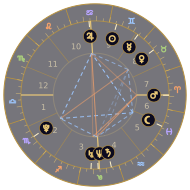
Cosmic Meridian sets a chosen moment against the real sky. Astronomy Engine casts it live in the browser — tropical, geocentric — as a natal chart, synastry, transits, Sky Now, a calendar, or a daily sign. The Astronomy Engine project documents the positions, coordinate transforms and sky events its library supports.
Who publishes this site
The publisher is Cosmic Meridian. The site is published under that name alone, and no individual is named on it. The only way to reach the publisher is the contact page.
What the calculation means
A chart is a map of celestial positions for a chosen moment. A verified time and a location let the workspace calculate angles and houses; when the time is unknown, it shows the possible planetary positions across the local birth date and withholds rising signs and houses. A noon estimate, where shown, is labelled and is not an exact birth position. Sky Now asks the device for location only after you choose it, and keeps it inside that calculation. The method page states the ephemeris, conventions, house systems and precision in detail.
What it does not claim
The visual language, forecasts, and star symbolism are invitations to reflect — not facts about a person, a guarantee, or medical, legal, financial, safety, or mental-health advice. Use the astronomical data for curiosity and observation, and make important decisions with appropriate real-world information.
Where the readings come from
Chart interpretations are selected from a fixed library of symbolic texts using the calculated placements. The birth-chart reading does not send your details to an AI service or generate a fresh AI response. You can explore the library alongside the astronomical positions; the interpretations are reflections, not scientifically established descriptions or predictions.
Editorial policy
The method page holds the facts behind this policy, including how each family of text is written and checked. Here are the rules in short.
Computed, not typed. Positions, signs, degrees, dates and phases come from the bundled astronomy library. On the sky pages, writers do not type them; they come from the engine.
AI-assisted drafting, then checks. Daily horoscope texts, event pages and chart readings are drafted with the help of AI. Each family has its own check against the engine or against a banned-phrase and repetition test.
What the site never does. It never presents a prediction as fact. It never gives money, legal or health advice. It never sends your birth details to an AI service.
Corrections. To report an error, send a message by way of the contact page naming the page and the figure. We check it against the engine, fix the page, and the page's updated date changes.
Private by design
An account is optional. Without one, birth details, coordinates, and results remain in the browser. If you sign in with Google and choose to keep a chart, only the birth details it needs are stored on your account, until you delete them. A signed-in account also keeps the weekly tarot card from Your sky and any note you write beside it. It keeps the people you choose to save, each with the name you give them and their birth details, until you delete them. If you start the membership beta, it records which feature and which of its two prices you pressed; nothing is charged. Aggregate cookieless page-view measurement never receives those inputs. Optional Microsoft Clarity session analytics runs only with your permission, excludes private account pages and masks chart content.
Data
City search uses the GeoNames gazetteer (CC BY 4.0, https://www.geonames.org/) bundled with this site; no lookup leaves your browser. Pre-1970 civil time in 15 zones — mostly the Low Countries, Scandinavia and the former Yugoslavia — comes from the IANA tzdata backzone file (public domain, release 2025c), compiled into the site. The zodiac figures drawn faintly behind the charts are redrawn from Johann Bayer's Uranometria (1603), a public-domain star atlas; the scans are on Wikimedia Commons.