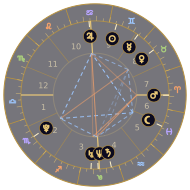
Solar eclipse
An annular eclipse, with the Sun in Aquarius. Greatest eclipse at 31.3° S, 48.5° W.
Tonight: first-quarter Moon in Capricorn, 53 % lit · Sun in Libra
Chart
Who you are at the minute you were born
Eclipses
As of 19 Oct 2026, the next solar eclipse is the annular eclipse of 6 Feb 2027, 15:59 UTC, in Aquarius. The next lunar eclipse is the penumbral eclipse of 20 Feb 2027, 23:12 UTC, in Virgo.
Next:
Next
The solar eclipse of 6 Feb 2027, 15:59 UTC is annular. At greatest eclipse the Moon covers about 86 % of the Sun's area and leaves a bright ring. The lunar eclipse of 20 Feb 2027 has the Moon in Virgo. Every time on this page is calculated in UTC, and your own zone is shown beside it once the page loads. Read the sections below for what each type means and how the dates are grouped.
An annular eclipse, with the Sun in Aquarius. Greatest eclipse at 31.3° S, 48.5° W.
A penumbral eclipse, with the Moon in Virgo. The Moon touches Earth's outer shadow at 20 Feb 2027, 21:11 UTC and leaves it at 21 Feb 2027, 01:13 UTC.
The geometry
An eclipse needs the Sun, the Earth and the Moon to fall close to one straight line. Most months the Moon passes a little above or below the Sun's path across the sky, so no eclipse happens. The Moon's orbit is tilted against that path, and the tilt is the reason eclipses are occasional rather than monthly.
The places where the Moon's orbit crosses the Sun's apparent path are called nodes. Read the ecliptic entry for the plain meaning of that path. An eclipse becomes possible only when the Sun is close to a node, and the Moon arrives there at the right phase.
A solar eclipse happens at new Moon, when the Moon slides between the Earth and the Sun. A lunar eclipse happens at full Moon, when the Earth's shadow falls across the Moon. The calculated moment is the same for every reader, and the list gives it in UTC to the minute.
Because the Sun, Moon and Earth keep moving, the timing of each eclipse comes from a calculation rather than a rule of thumb. The ephemeris is the table of body positions that a calculation like this draws on. Use it when you want the exact placement of the Sun or Moon on a given day.
Each row of the list gives the instant, the kind, the type and the sign the Sun or Moon occupies at that moment. The sign is a stretch of the zodiac, not a separate event. Read the times first, then the labels, and the rest of the table will follow.
Every eclipse
The list below runs through 2036 and gives every eclipse from 19 Oct 2026 onward, in date order. Each entry carries its kind, its type, its calculated time in UTC and the sign the Sun or Moon occupies at that moment. Use the list when you want the whole run of dates instead of only the next one. The entries describe the sky at a moment. They do not describe what a given week or a given person will hold.
| Instant | Kind | Type | Sign |
|---|---|---|---|
| Solar eclipse | annular Greatest eclipse at 31.3° S, 48.5° W. | Aquarius | |
| Lunar eclipse | penumbral | Virgo | |
| Lunar eclipse | penumbral | Capricorn | |
| Solar eclipse | total Greatest eclipse at 25.5° N, 33.2° E. | Leo | |
| Lunar eclipse | penumbral | Aquarius |
| Instant | Kind | Type | Sign |
|---|---|---|---|
| Lunar eclipse | partial | Cancer | |
| Solar eclipse | annular Greatest eclipse at 3° N, 51.5° W. | Aquarius | |
| Lunar eclipse | partial | Capricorn | |
| Solar eclipse | total Greatest eclipse at 15.6° S, 126.7° E. | Cancer | |
| Lunar eclipse | total | Cancer |
| Instant | Kind | Type | Sign |
|---|---|---|---|
| Solar eclipse | partial | Capricorn | |
| Solar eclipse | partial | Gemini | |
| Lunar eclipse | total | Capricorn | |
| Solar eclipse | partial | Cancer | |
| Solar eclipse | partial | Sagittarius | |
| Lunar eclipse | total | Gemini |
| Instant | Kind | Type | Sign |
|---|---|---|---|
| Solar eclipse | annular Greatest eclipse at 56.5° N, 80.1° E. | Gemini | |
| Lunar eclipse | partial | Sagittarius | |
| Solar eclipse | total Greatest eclipse at 43.6° S, 71.2° E. | Sagittarius | |
| Lunar eclipse | penumbral | Gemini |
| Instant | Kind | Type | Sign |
|---|---|---|---|
| Lunar eclipse | penumbral | Scorpio | |
| Solar eclipse | annular Greatest eclipse at 8.9° N, 71.7° E. | Gemini | |
| Lunar eclipse | penumbral | Sagittarius | |
| Lunar eclipse | penumbral | Taurus | |
| Solar eclipse | total Greatest eclipse at 0.6° S, 137.6° W. | Scorpio |
| Instant | Kind | Type | Sign |
|---|---|---|---|
| Lunar eclipse | total | Scorpio | |
| Solar eclipse | annular Greatest eclipse at 51.3° S, 7° W. | Taurus | |
| Lunar eclipse | total | Aries | |
| Solar eclipse | partial | Scorpio |
| Instant | Kind | Type | Sign |
|---|---|---|---|
| Solar eclipse | total Greatest eclipse at 71.3° N, 155.6° W. | Aries | |
| Lunar eclipse | total | Libra | |
| Solar eclipse | partial | Libra | |
| Lunar eclipse | total | Aries |
| Instant | Kind | Type | Sign |
|---|---|---|---|
| Solar eclipse | total Greatest eclipse at 16° N, 22.2° E. | Pisces | |
| Lunar eclipse | penumbral | Libra | |
| Solar eclipse | annular Greatest eclipse at 18.2° S, 72.6° W. | Virgo | |
| Lunar eclipse | partial | Aries |
| Instant | Kind | Type | Sign |
|---|---|---|---|
| Lunar eclipse | penumbral | Virgo | |
| Solar eclipse | annular Greatest eclipse at 29.1° S, 154.9° W. | Pisces | |
| Lunar eclipse | partial | Aquarius | |
| Solar eclipse | total Greatest eclipse at 29.1° N, 158° E. | Virgo |
| Instant | Kind | Type | Sign |
|---|---|---|---|
| Lunar eclipse | total | Leo | |
| Solar eclipse | partial | Pisces | |
| Solar eclipse | partial | Leo | |
| Lunar eclipse | total | Aquarius | |
| Solar eclipse | partial | Leo |
Kinds
Eclipses come in a few types, and the type depends on how much of the disc is covered and which shadow does the covering. A total solar eclipse covers the whole disc of the Sun for a short stretch. An annular eclipse leaves a bright ring at the edge, because the Moon looks slightly smaller than the Sun at that distance. A partial solar eclipse covers only part of the disc, and the rest stays bright. A hybrid eclipse shifts between annular and total along its path.
The type on each row is the label from the calculation. This calculation does not label hybrid eclipses separately; a hybrid appears in the table as total or annular. The solar eclipse of 6 Feb 2027, 15:59 UTC is annular. At greatest eclipse the Moon covers about 86 % of the Sun's area and leaves a bright ring. Obscuration is the fraction of the Sun's area covered at the greatest point. A total eclipse covers all of it. The cover sentence above says what the calculation gives for the eclipse of 6 Feb 2027, 15:59 UTC.
The greatest-eclipse point of the 6 Feb 2027 solar eclipse is at 31.3° S, 48.5° W. That point is where the centre of the shadow passes closest to the middle of the Earth.
A partial solar eclipse is recorded by its time alone when the calculation gives no greatest point. Those rows still belong to the list, and they still have a calculated moment in UTC.
Lunar eclipses follow the same logic at full Moon, but the shadow is the Earth's. A total lunar eclipse carries the Moon fully into the umbra, the dark core of the shadow. A partial lunar eclipse covers only part of the Moon. A penumbral lunar eclipse passes the Moon through the outer, lighter part of the shadow, and the dimming is subtle. The lunar eclipse of 20 Feb 2027 is penumbral.
The penumbral part of a lunar eclipse has its own contact times, which this page gives as clock times in UTC. For the lunar eclipse of 20 Feb 2027, the penumbral phase runs from 20 Feb 2027, 21:11 UTC to 21 Feb 2027, 01:13 UTC. Those times matter more than the label, because the change in light is gradual and easy to miss at the start.
The type is a label from the same calculation that gives the time. Use the type to understand what you are looking for, and the time to decide when to look.
Blood moon
The total lunar eclipse of 31 Dec 2028, 16:51 UTC falls in Cancer. This is the eclipse people call a blood moon. The Moon turns a dull red or copper colour while it sits inside the umbra, and the shade shifts from one eclipse to the next.
The reddish light is sunlight that has bent through Earth's atmosphere on its way to the Moon.
The calculated totality lasts 72 minutes. Totality starts at 31 Dec 2028, 16:15 UTC and ends at 31 Dec 2028, 17:28 UTC. The partial phase opens earlier, at 31 Dec 2028, 15:07 UTC, and the penumbral phase opens earliest, at 31 Dec 2028, 14:03 UTC.
The clock times give the full arc of the event. The penumbral phase is the faint outer shading. The partial phase is the bite into the bright disc. Totality is the stretch when the whole Moon sits in the umbra. Read the times as a single run, not as separate events.
Because the name comes from colour, the colour is the part that varies most. A calm way to approach it is to look at the Moon for the whole span and notice the change, rather than to expect a particular shade.
The total lunar eclipse of falls with the Moon in Cancer; totality lasts about 72 minutes. Every blood moon to the end of the tables is on the blood moon page.
Eclipse seasons
The eclipse seasons are grouped in the numbered list the way the sky groups them. A season is a short stretch of the year in which the Sun comes close enough to the Moon's crossing point for an eclipse to happen. Some seasons hold more than one eclipse, and each item in the list names the eclipses inside its span of dates.
The first group listed runs 6 Feb 2027 – 20 Feb 2027, with an annular solar eclipse and a penumbral lunar eclipse. Any later groups follow the same logic, each with its own span of dates and its own signs.
The grouping is a convenience of the list. Each item gives a span of dates and names the eclipses inside it. A span of dates is never an event on its own, and the exact moment of each upcoming eclipse is in the tables above, in UTC. A season already under way also names its earlier eclipse.
Each eclipse named in an item carries a type, a kind and a sign. The sign tells you where the Sun or Moon sits in the zodiac at that moment, and the zodiac dates page shows when each sign begins.
Read an item the way you would read a short line. Take each eclipse in turn, check its type, and then see how they sit beside each other.
Watching safely
Start with the time. Every moment on this page is in UTC, so convert it to your own clock before you plan anything. The solar eclipse of 6 Feb 2027, 15:59 UTC and the total lunar eclipse of 31 Dec 2028, 16:51 UTC are the two dates to plan around.
Choose a place with a clear, open view of the sky, and check the weather a day ahead. A kitchen table by a window, a flat roof or a quiet walk can all work when the sky is open where you stand.
Use only a solar filter made for eclipse viewing whenever you look at the Sun.
A lunar eclipse needs no filter. The Moon is safe to look at with the naked eye, with binoculars or with a telescope, and the dimming can be followed over a few hours.
Plan your viewing around the contact times. For the total lunar eclipse of 31 Dec 2028, 16:51 UTC, totality runs from 31 Dec 2028, 16:15 UTC to 31 Dec 2028, 17:28 UTC. The partial phases frame it on either side.
For a total solar eclipse, the darkening comes on quickly and the light changes across the ground. Watch the shadows, the colour of the sky near the horizon, and the air, which often cools. Notice these things with your own senses rather than through a camera.
Watch with someone else if you can. A shared count of minutes makes a long wait feel shorter, and it gives you someone to compare notes with afterwards.
Bring a warm layer, a chair and a notebook. Write down the time when the colour changes, when the light shifts and when the stage ends, because your memory of the minutes will blur.
The lunation cycle explains why a full Moon comes round again each month, which is useful background for the lunar eclipse dates. The exact moments on this page come from the calculation, so use the lunation idea for the general rhythm and the listed times for the plan.
The solar eclipse of 6 Feb 2027, 15:59 UTC is annular. At greatest eclipse the Moon covers about 86 % of the Sun's area and leaves a bright ring. The Sun and Moon sit in Aquarius at that moment. A solar eclipse happens at new Moon, when the Moon passes between the Earth and the Sun. Convert the UTC time to your own clock first.
The lunar eclipse of 20 Feb 2027, 23:12 UTC is penumbral. The Moon passes only through Earth's faint outer shadow. The Moon is in Virgo at that time. A lunar eclipse happens at full Moon, when the Earth's shadow falls across the Moon. Its penumbral phase begins at 20 Feb 2027, 21:11 UTC and ends at 21 Feb 2027, 01:13 UTC, both in UTC.
The blood moon is the total lunar eclipse of 31 Dec 2028, 16:51 UTC. The Moon is in Cancer at that moment. Totality is calculated to last 72 minutes, between 31 Dec 2028, 16:15 UTC and 31 Dec 2028, 17:28 UTC. Blood moon is the popular name for a Moon in full eclipse, and the calculated times here describe that same event.
This page does not describe where any eclipse can be seen. It gives the calculated moment of each event in UTC, and for total and annular solar eclipses it gives the greatest-eclipse point. The moment is the same everywhere. Whether the sky is open to you depends on your own place and the weather on the day, so check a local sky almanac for your position.
Eclipses need the Sun, Earth and Moon to line up closely. The Moon's orbit is tilted against the Sun's path across the sky, so in most months the Moon passes above or below that path. An eclipse needs the Moon to cross the path close to new Moon or full Moon. Those crossings fall within certain stretches of the year, which the list groups as seasons.
The solar eclipse of 6 Feb 2027, 15:59 UTC falls in Aquarius, and the lunar eclipse of 20 Feb 2027, 23:12 UTC falls in Virgo. A sign here is a named stretch of the zodiac, read from the position of the Sun or Moon at that moment. It describes a place in the sky and nothing else, not an outcome for you.
Method & limits
Every date here is computed with Astronomy Engine, run once into this site's event tables. They are geocentric, in the tropical zodiac, in UTC to the minute, with your own zone beside them once the page loads. The sentence at the top is dated for the data date shown at the top, midnight UTC. Your browser corrects it against your own clock. Readings are for reflection, never health, legal or money guidance. Nothing about you is sent anywhere.